


 Back to Insights & Updates


Holistic Architecture for A Reliable and Collaborative Multi-Stakeholder Agentic AI System in Healthcare
Abstract: The U.S. healthcare system stands at a pivotal inflection point, as structural pressures including aging populations, rising chronic disease burdens, escalating costs, and clinician burnout intersect with the rapid growth of digital health data and breakthroughs in artificial intelligence (AI). Amid these dynamics, a transformative vision is emerging in which doctors, nurses, and AI agents collaborate as integrated members of the care team. This paper examines the integration of agentic AI, defined here as intelligent systems capable of reasoning, coordination, adaptive learning, and goal-directed action within defined clinical boundaries. This technology is reshaping healthcare delivery and management through collaborative human-AI workflows that improve decision-making, efficiency, and compassion. Human strengths such as empathy, contextual judgment, and ethical reasoning can be complemented by AI systems that automate routine tasks, synthesize multimodal data, and generate timely insights. To operationalize this vision, the paper proposes a conceptual Holistic Clinical Intelligence Architecture (HCIA), a framework that coordinates specialized AI agents through a Clinical Coordination Agent, grounds recommendations in a Longitudinal Patient Intelligence Model, supports controlled improvement through an Adaptive AI Learning Layer, and preserves clinician oversight through embedded governance and safety mechanisms. By extending these capabilities across clinical care, research, public health, and healthcare operations, agentic AI has the potential to drive innovation and enhance the effectiveness of modern health systems. The potential for agentic AI to transform the healthcare industry demands more than technological advancement. Trust, transparency, interoperability, and equity must be embedded throughout any human-AI ecosystem, supported by adaptive regulatory frameworks and a workforce equipped for continual learning and change. Recommendations for healthcare organizations, AI developers, policymakers, and cross-sector partnerships conclude this article. Together, these stakeholders can cultivate a healthcare system that is efficient, equitable, and compassionate. The expertise and empathy of clinicians remain irreplaceable, yet they can be amplified by intelligent agents that enable healthcare professionals to deliver more proactive, predictive, and personalized care.
Navigating a Changing Healthcare Landscape
Healthcare today is marked by unprecedented challenges. The U.S. population is older than ever before, and the number of adults aged 65 and older is projected to grow by approximately 42% by 2050 (PRB, 2024). Chronic disease remains prevalent in many parts of the country (Benavidez et al., 2024). Rising costs of healthcare services, prescription drugs, and medical treatments, which have outpaced general inflation, have driven up insurance premiums and placed growing financial pressure on both patients and employers (Cox et al., 2025). These challenges continue to strain healthcare systems across the United States, with clinician burnout and workforce shortages further intensifying the pressure (Khullar, 2023). At the same time, patients and policymakers are increasingly calling for care that is higher in quality, more personalized, and more readily accessible.
On the technological front, the widespread adoption of electronic health records (EHRs), digital imaging, wearable sensors, and telemedicine has generated vast volumes of digital health data. Advances in artificial intelligence are increasingly transforming these data streams into practical clinical tools that support diagnosis, monitoring, and decision-making. For instance, deep learning systems now match or exceed human performance in radiology pattern recognition (Ha et al., 2025; Lyu et al., 2026); and large language models (LLMs) can rapidly synthesize clinical evidence and perform diagnostic reasoning (Brodeur et al., 2026; Wang et al., 2025). Recent studies have expanded beyond benchmark evaluations to assess LLMs in real clinical tasks, demonstrating strong performance in clinical reasoning and decision support across real-world tasks, while continuing to face limitations in reliability, consistency, and generalizability (Bedi et al., 2026; Liu et al., 2026). As healthcare data volume and complexity increase, research in agentic AI gains traction. This reflects a growing recognition that AI systems capable of proactive, goal-directed reasoning may offer a promising approach to managing this complexity (Liu et al., 2025).
The adoption of agentic AI to meet the needs of a strained healthcare system signals the emergence of a new era, one in which AI has evolved from a collection of passive analytical tools into active collaborators within clinical teams. The earliest medical AI systems, such as the rule-based diagnostic programs of the 1970s including MYCIN, revealed the potential of computational reasoning but were constrained by static logic and limited integration of diverse data sources (Marfo & Arnost, 2026). Building on these early foundations, modern agentic AI systems integrate multimodal intelligence across imaging, text, and genomic data, enabling networked agents to collaborate dynamically and adapt to complex clinical contexts. These advances are giving rise to a cognitive ecosystem in which digital agents augment nearly every dimension of care delivery, including clinical decision support, biomedical research, and public health operations (Schouten et al., 2025; Patel et al., 2025).
Nonetheless, this transformation must be navigated carefully. Clinical settings demand accuracy and trust as the margin for error is narrow. Integration of new AI systems must honor workflow realities and regulatory requirements. Against this backdrop, the following sections examine how the medical acumen of doctors and nurses can complement AI agents, and how together they can build a more resilient, innovative, and patient-centered healthcare ecosystem. The paper later translates this vision into HCIA, a proposed architecture for coordinating specialized AI agents into a trusted clinical intelligence ecosystem that supports clinicians and preserves human oversight.
The Art and Science of Healing
Doctors, nurses, and caregivers are the cornerstones of medical care. They possess:
- Clinical experience & judgment. Years of training and practice give clinicians a rich knowledge of medicine. They recognize subtle patterns, weigh complex trade-offs, and apply creativity to unusual cases. A physician can integrate physical examination findings, laboratory results, and patient history within context, demonstrating diagnostic reasoning skills.
- Empathy & communication. Healthcare providers excel at perceiving emotion, interpreting nuance, and earning trust through authentic connection. A nurse’s calm presence or a physician’s thoughtful explanation can reduce anxiety, improve adherence, and align treatment with a patient’s values. Emotional intelligence helps manage patient expectations, support shared decision-making, and maintain dignity during care (Ding & Xing, 2025).
- Contextual understanding. Clinicians are often trained to consider the whole person, including family circumstances, lifestyle, and beliefs. For example, a physician might tailor a treatment plan knowing a patient’s work schedule or health literacy. Such situational awareness, i.e., contextualizing medical knowledge with broader aspects of a patient’s life, is a skill unique to humans (Schuler et al., 2025).
- Teamwork and adaptability. Hospitals and clinics rely on interdisciplinary teams in which nurses coordinate with specialists, therapists, and families to ensure seamless care, quickly adapting to health emergencies. Humans excel at flexible, context-aware planning. When a patient has multiple comorbidities, the care plan may evolve through team discussions that integrate clinical priorities, patient preferences, and changing circumstances, areas where current AI systems remain vulnerable to contextual errors (Li et al., 2025).
Although clinicians possess distinctive strengths, they can face inherent limitations that may impact efficiency and consistency in practice. Physicians and nurses continue to experience high levels of stress associated with documentation, billing, and other administrative demands. These responsibilities take time and attention away from direct patient care and contribute significantly to clinician burnout. Tasks such as recordkeeping, scheduling, and coding remain essential to healthcare operations, yet they are largely repetitive and nonclinical. By automating these functions, agentic AI can help restore clinicians’ capacity to concentrate on activities that require empathy, critical judgment, and collaboration.
In short, human care providers excel in domains that demand empathy, ethical discernment, and complex reasoning. Strengthening an otherwise strained healthcare system requires building upon these intrinsic strengths while relieving clinicians of repetitive and administrative burdens. This vision defines the next frontier in healthcare, where agentic AI systems collaborate with clinical teams by coordinating specialized intelligence while preserving human judgment, accountability, and patient-centered care.
Rise of Agentic AI in Healthcare from Labs to Bedside and Beyond
The current generation of agentic AI builds on decades of progress in medical informatics and machine learning. Earlier systems could analyze data and offer static recommendations, but they lacked adaptability and contextual awareness. With advances in neural architectures, computational power, and multimodal integration, those limitations have evolved into new capabilities. Modern agentic systems can interpret complex clinical signals, connect insights across imaging, text, and genomics, and coordinate actions through networked agents. Recent research on multi-agent AI systems shows that networks of specialized agents can effectively coordinate complex reasoning, execute tasks, and manage autonomous workflows. These capabilities are enabled by emerging multi-agent architectures and orchestration frameworks and are further validated through analyses of real-world deployed systems (Sapkota, Roumeliotis, & Karkee 2025); Staufer et al., 2026). In this emerging paradigm, AI functions not as a passive tool but as an active collaborator, supporting clinicians in reasoning, planning, and adaptive problem solving across the continuum of care. These capabilities are already reshaping care delivery at multiple levels from bedside interactions to the broader structures of healthcare systems.
Applications in Clinical Practice
Agentic AI is already demonstrating a measurable impact within clinical environments. The following examples illustrate how intelligent agents are being integrated into everyday healthcare delivery to support decision-making, reduce administrative burden, and enhance patient engagement.
- Clinical decision support & diagnostics. AI agents can now analyze vast and heterogeneous clinical data streams to detect anomalies and support diagnostic reasoning. Integrated LLMs synthesize information from EHRs, laboratory results, and imaging studies to generate differential diagnoses or flag potential medication conflicts. Multimodal agents extend this capability by combining imaging data with patient histories and genomic information, improving diagnostic precision and contextual understanding. Through continuous learning and adaptive reasoning, these systems enhance accuracy, efficiency, and timeliness of clinical decision-making, ultimately supporting clinicians in delivering personalized, evidence-based care (Liu et al., 2025). In parallel, recent work has shifted toward task-based evaluation of medical AI systems, with frameworks such as MedHELM assessing performance within real clinical workflows rather than relying solely on benchmark examinations (Bedi et al., 2026).
- Workflow & administrative tasks. Agents can automate a wide range of time-consuming administrative tasks, such as completing forms, verifying insurance details, and scheduling appointments. Studies suggest that this type of automation can meaningfully reduce the clerical burden on clinicians (Lavoie-Gagne et al., 2025). In practice, systems like NYUTron, deployed at NYU Langone Health System, help predict readmission risk and manage billing, freeing staff to focus more on patient-facing work (Chirigati, 2023). Recent real-world studies further show that ambient AI documentation systems can improve not only efficiency but also physician productivity and overall operational performance in clinical settings (Holmgren et al., 2026). Consistent with these findings, time-motion studies across diverse healthcare systems demonstrate measurable shifts in clinician workload and time allocation following the deployment of ambient AI tools (Tan et al., 2026).
- Patient engagement & monitoring. Patient-facing AI agents are evolving beyond simple chatbots into intelligent, multimodal systems that support continuous engagement, remote monitoring, and timely escalation. Voice- and text-based agents can triage symptoms, answer routine questions, reinforce medication adherence, and personalize outreach based on patient context. More advanced systems integrate wearable and ambient sensor data to detect deviations from a person’s physiological patterns and translate those signals into clinically meaningful alerts for care teams (Gabrielli et al., 2025). Emerging agentic messaging frameworks also show how AI can optimize patient communication at scale, improving engagement through tailored, data-driven outreach (Luo et al., 2025). Together, these capabilities extend care beyond hospital visits to support recovery, chronic disease management, and earlier intervention when risk signals emerge.
- Surgery and robotics. Agentic AI is transforming robotic surgery from rigid automation to adaptive collaboration. Recent work such as SurgRAW shows how multi-agent frameworks can combine chain-of-thought (CoT) reasoning with retrieval-augmented generation (RAG) to support surgical intelligence tasks like instrument recognition, action prediction, and outcome assessment, reducing errors and improving logical consistency (Low et al., 2026). Complementing this, the Perception Agent enables natural human-machine interaction by integrating LLMs, segment anything model (SAM), and memory repositories to flexibly identify both known and novel elements (e.g., instruments, grafts, and gauze) in real time, supporting intuitive and adaptive intraoperative assistance (Seenivasan et al., 2025). Together, these advances demonstrate a shift toward surgical robots that act as dynamic teammates, enhancing precision and decision-making while clinicians maintain oversight.
Transformation Across the Healthcare Ecosystem
Agentic AI is reshaping the broader healthcare landscape. The examples below highlight its role in advancing pharmaceutical research, strengthening public health systems, and improving payer efficiency and equity.
- Pharmaceutical research & development. Agentic AI is accelerating drug discovery and development. Systems such as DrugAgent autonomously generate and test models for ADMET (Absorption, Distribution, Metabolism, Excretion, and Toxicity), improving over traditional methods (Liu et al., 2024). The emerging AI co-scientist paradigm, involving multi-agent systems that autonomously refine hypotheses about potential molecular drug targets and the disease mechanisms they affect, is poised to reduce researchers’ workload and accelerate scientific discovery (Gottweis et al., 2026). This technology promises to shorten timelines for bringing therapies to market, benefitting patients worldwide.
- Public & global health. Public health agencies can leverage AI agents for surveillance and preventative care. Predictive models can identify emerging disease outbreaks from data and trigger targeted interventions before outbreaks escalate. Agentic AI also holds promise for expanding global health initiatives by addressing disparities in resource-limited regions and improving equitable access to care (Karunanayake, 2025). In practice, AI-driven telehealth kiosks in remote communities and mobile care units coordinating vaccination campaigns through local epidemiological analysis illustrate how these systems can extend the reach of healthcare providers. Collectively, such innovations have the potential to democratize access to medical expertise across borders.
- Insurance and payers. Insurance companies are increasingly adopting AI solutions to streamline claims management and fraud detection. Systems such as NYUTron have demonstrated the ability to improve predictive performance on both clinical and operational tasks, including the prediction of insurance claim denials and readmissions, by leveraging unstructured clinical notes in EHR data. (Jiang et al., 2023). Beyond these applications, agentic systems can automate routine underwriting, personalize plan recommendations, and detect billing irregularities. Survey and intervention data indicate that many clinicians support offloading administrative tasks such as benefits verification and care-gap identification to intelligent agents, recognizing their potential for reducing documentation time and cognitive workload (Olson et al., 2025). Strengthening collaboration between providers and payers through these technologies can lower costs, reduce administrative inefficiencies, and enhance the overall performance and coordination of the healthcare system.
These cases represent only the early stage of a much broader transformation. The true value of agentic systems will emerge when multiple AI agents collaborate rather than operate independently. This shift creates the need for an organizing architecture such as HCIA, which can coordinate specialized AI agents, maintain a longitudinal patient context, and present coherent recommendations to clinicians. For example, while one agent is handling transcription, another can analyze laboratory data, and a third can process treatment codes, together producing a unified, comprehensive patient view. These examples show why agentic AI must evolve from isolated tools into coordinated systems that support a unified view of patient care. In all respects, the objective is to augment human capabilities, allowing them to focus on higher value tasks. In pharmaceuticals, scientists can dedicate more time to experimental design rather than model tuning. In public health, officials can prioritize strategic action over data sorting. The healthcare ecosystem is steadily moving toward cognitive automation, while clinicians continue to provide strategic oversight and ethical judgment. A side-by-side comparison listing the complementary strengths of agentic AI and clinicians is shown in Table 1.
Table 1. Complementary strengths of clinicians and AI agents in healthcare.
| Role/Function | Clinician (Doctor/Nurse) | AI Agent |
|---|---|---|
| Diagnostics & Planning | -Experience-driven differential diagnosis -Patient case review with peers | -Pattern recognition across complex and large data -Advanced descriptive, diagnostic, predictive, and prescriptive analysis |
| Communication & Empathy | -Empathetic listening -Trust-building -Nuanced communication | -24/7 virtual support -General consistency in information processing |
| Administrative Tasks | -Workflow oversight -Ethically focused decision-making | -High-speed data collection and entry -Scheduling automation -Automated medical procedure coding |
| Education & Training | -Mentoring -Hands-on training | -Individually customized tutoring and performance monitoring -Simulation feedback |
A Collaborative Framework for Human-AI Teams to Transform Healthcare
Healthcare AI is rapidly evolving into an ecosystem of specialized intelligent systems. Independent models now support a wide range of clinical functions, from diagnostic interpretation and laboratory analysis to documentation, patient communication, remote monitoring, and workflow management. Although these systems can perform well within individual domains, they often operate in isolation. Clinicians are still left to navigate multiple applications, reconcile disconnected outputs, and translate fragmented recommendations into coherent decisions. As healthcare organizations deploy more specialized AI capabilities, the primary challenge is shifting from building individual models to harmonizing them into a unified intelligence system that complements clinical practice.
To address this challenge, we propose the Holistic Clinical Intelligence Architecture (HCIA), a human-centered framework for coordinating specialized AI agents across the healthcare-focused enterprise. HCIA does not replace existing AI systems. Instead, it provides an orchestration structure that allows them to work together as part of a digital clinical team. Each AI agent contributes domain-specific expertise, while a central coordination agent manages communication, reasoning, workflow, and clinician interaction. Human healthcare professionals remain responsible for clinical decisions, while HCIA reduces the time and cognitive burdens of gathering and synthesizing information from complex healthcare environments.
At the core of HCIA is the Clinical Coordination Agent (CCA), an intelligent orchestration component that manages the flow of information throughout the healthcare ecosystem. Unlike conventional workflow engines that execute predefined processes, the CCA adapts to the clinical objective. It breaks complex problems into smaller tasks, selects the relevant AI agents, coordinates their work, and integrates their outputs into a unified recommendation. The CCA also performs reasoning and evidence integration by evaluating supporting evidence, identifying agreement or disagreement among agents, retrieving relevant clinical guidelines, estimating confidence, and generating transparent explanations. For example, evaluating a patient with worsening heart failure may require evidence from several sources, including laboratory trends, echocardiography, medication history, wearable sensor data, prior clinical notes, and current treatment guidelines. Rather than requiring clinicians to manually collect this information, the CCA gathers evidence from the appropriate intelligence agents, resolves conflicting findings, prioritizes clinically significant information, and presents recommendations, explanations, and alerts to the human care team for review.
Supporting the coordination agent is a set of Specialized Clinical Intelligence Agents, each optimized for a specific domain. Some agents focus on clinical interpretation, such as radiology, pathology, laboratory analysis, and medication management, while others support workflow and communication, including clinical documentation, speech recognition, scheduling, and patient engagement. Additional agents provide knowledge retrieval, remote monitoring, population health analytics, genomics, and billing or coding support. Each agent performs task-specific analysis within a defined scope while communicating through standardized interfaces managed by the CCA. This modular design allows healthcare organizations to add future AI capabilities without redesigning the entire system.
A distinguishing feature of HCIA is the Longitudinal Patient Intelligence Model (LPIM), which serves as the AI-supported patient context for the architecture. Unlike traditional electronic health records that primarily store historical information, the LPIM maintains a dynamic representation of each patient’s status across time. It integrates clinical history, medications, laboratory and imaging trends, genomic information, wearable data, preferences, prior decisions, treatment responses, and outcomes into a unified patient context. Because every intelligence agent can reason from the same patient representation, recommendations remain consistent across encounters. This supports personalized, longitudinal decision-making rather than isolated point-in-time analysis.
HCIA also includes a Patient-Facing Data Translation and Application component that serves as the interface between enterprise healthcare data and patient engagement. Operating alongside the core HCIA intelligence layers, it converts selected clinical records, results, and care information into personalized, plain-language summaries, reminders, and care updates, while capturing structured patient updates, preferences, symptoms, and consent for integration into healthcare systems. This component supports patient engagement while preserving clinician authority over diagnosis and treatment decisions.
Building on the LPIM, HCIA includes an Adaptive AI Learning Layer that supports continuous improvement without compromising patient safety. The architecture evaluates its performance using clinician feedback, patient outcomes, and operational metrics to identify opportunities for refinement. Proposed updates undergo structured validation through simulation testing, bias assessment, safety evaluation, and clinical review before deployment. By requiring every improvement to pass through this controlled process, HCIA evolves while maintaining regulatory compliance, clinical reliability, and human oversight.
These learning and coordination processes require robust safeguards. To support this, HCIA incorporates a cross-cutting Governance, Safety, and Trust Layer that spans the entire architecture. Every interaction among AI agents is recorded in a comprehensive audit trail, making it possible to trace how recommendations are generated and how decisions evolve over time. Governance policies ensure that each agent operates only within its authorized scope, while continuous monitoring detects unexpected behavior or performance degradation. When recommendations involve elevated uncertainty or clinical risk, they are automatically escalated to the care team for review before any action is taken. Together, these safeguards ensure that HCIA remains transparent, accountable, and safe while supporting regulatory compliance.
Figure 1 presents HCIA as a layered architecture that connects specialized AI agents, longitudinal patient intelligence, adaptive learning, patient-facing application, and clinician oversight within one coordinated system.
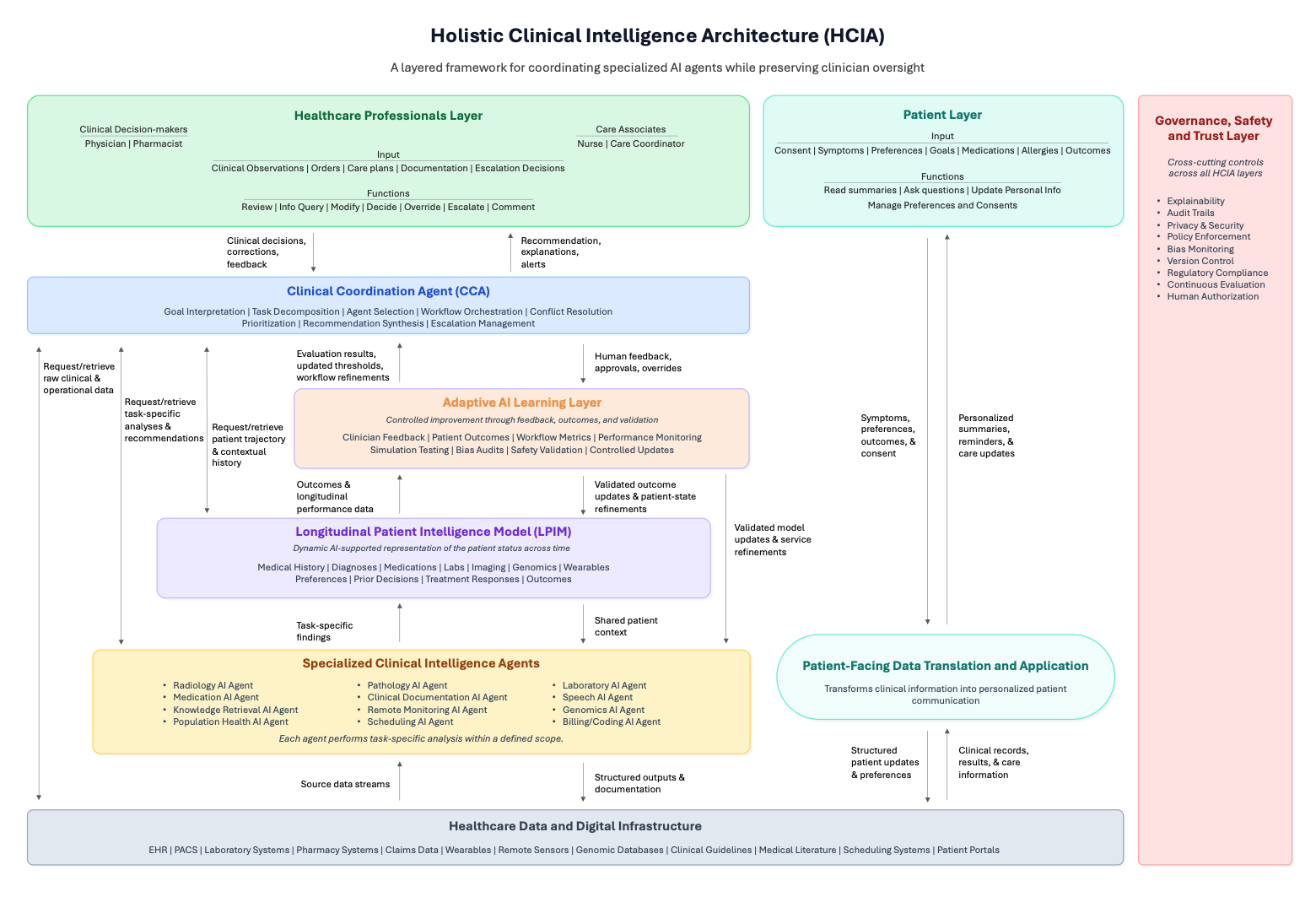
Figure 1. Holistic Clinical Intelligence Architecture (HCIA). Specialized Clinical Intelligence Agents are coordinated through the Clinical Coordination Agent and grounded in the Longitudinal Patient Intelligence Model. The Adaptive AI Learning Layer supports controlled improvement through feedback, outcomes, and validation, while Patient-Facing Data Translation and Application translates clinical information into personalized patient communications. Simultaneously, structured patient updates are captured for integration into healthcare systems. Governance, Safety, and Trust operate across all layers, and clinicians retain authority over final care decisions.
Architectural Design Principles of HCIA
The following design principles explain how HCIA governs collaboration between clinicians and intelligent agents in practice. The effectiveness of HCIA depends not only on its architectural components but also on the principles that govern collaboration between clinicians and intelligent systems.
- Human governance and clinical oversight. Every recommendation generated by the architecture remains subject to clinician supervision. The Clinical Coordination Agent assigns levels of confidence and clinical risk to each recommendation, enabling healthcare professionals to determine the appropriate level of review. Routine administrative tasks may require minimal intervention, while high-risk clinical activities, such as diagnosis, medication changes, and treatment planning, require explicit clinician approval. Structured escalation pathways ensure that ambiguous findings, conflicting evidence, or deteriorating patient conditions are immediately referred to human experts. This governance model preserves clinician accountability while enabling AI systems to operate efficiently within clearly defined clinical boundaries, consistent with recent recommendations for meaningful human oversight of medical AI (van de Sande, Economou-Zavlanos, & van Genderen, 2026).
- Intelligent task allocation. HCIA distributes work according to the complementary strengths of clinicians and AI agents. Specialized intelligence agents handle computationally intensive work, including image interpretation, laboratory analysis, record summarization, documentation, and evidence synthesis. Clinicians concentrate on contextual reasoning, ethical judgment, communication, and shared decision-making with patients. By redistributing repetitive cognitive tasks, the architecture is designed to allow healthcare professionals to devote greater attention to complex clinical decisions and patient care. Recent studies illustrate how clinicians and AI can share the work of clinical documentation. Clinicians who adopted AI scribes spent less time documenting, and physician reviewers were more likely to approve AI-generated discharge summaries with minor or no edits than summaries written by clinicians. (Goldsmith et al., 2026; Rotenstein et al., 2026).
- Distributed clinical intelligence. Rather than relying on a single monolithic AI model, HCIA coordinates specialized intelligence agents that function as distributed clinical experts. Some agents contribute diagnostic expertise, such as radiology, pathology, and laboratory interpretation. Others support medication management, documentation, and remote monitoring. Each agent provides domain-specific analysis while reasoning from the shared Longitudinal Patient Intelligence Model. The Clinical Coordination Agent synthesizes these perspectives into a unified recommendation, much like multidisciplinary care teams combine expertise to guide patient care. This collaborative approach reflects emerging advances in multi-agent AI, where coordinated networks of specialized agents solve complex scientific and clinical problems more effectively than isolated models (CZ Biohub Network, 2025; Liu et al., 2026). As specialized AI capabilities expand, coordinated intelligence architectures will become increasingly important for scalable, trustworthy, and clinically integrated healthcare.
- Adaptive AI learning and system evolution. HCIA supports iterative improvement by learning from clinician feedback, patient outcomes, and overall system performance. Recommendations that are accepted, modified, or rejected provide valuable signals for future refinement, while outcome monitoring evaluates the real-world system effectiveness. All improvements undergo controlled validation and safety assessment before deployment, ensuring that adaptation occurs within a rigorous governance framework consistent with regulatory expectations for adaptive medical AI.
- Human interaction and clinical experience. Effective collaboration depends on interfaces that communicate AI reasoning clearly and fit naturally within clinical workflows. For the care team, HCIA presents recommendations, supporting evidence, confidence estimates, and transparent explanations rather than isolated predictions. Clinicians may query the system through voice or text, review agent-generated findings, and approve, modify, reject, or escalate recommendations. Beyond receiving coordinated recommendations, clinicians can directly access source clinical data, review outputs from specialized intelligence agents, and explore the longitudinal patient context maintained by the LPIM. These direct pathways allow clinicians to verify AI outputs, compare recommendations against source records, and preserve independent clinical judgment. When appropriate, HCIA also supports patient engagement through the Patient-Facing Data Translation and Application component, which delivers personalized summaries, reminders, and care updates while capturing structured patient-reported information. Rather than becoming another application that clinicians must manage, the architecture functions as an intelligent clinical partner that coordinates information while remaining responsive to human guidance.
Achieving widespread adoption of HCIA will require investment beyond technology alone. Healthcare organizations must strengthen AI literacy, redesign workflows with clinicians, and establish governance structures that support safe deployment. As specialized AI agents continue to proliferate, the central challenge will be coordination rather than model development alone. The future of healthcare will depend on systems that integrate diverse AI capabilities into trustworthy, collaborative, and clinically meaningful care.
Trust, Ethics, and Safety: Building a Responsible AI Framework
A sustainable ecosystem for human-AI collaboration relies on trust and safeguards embedded across every stage of system design and deployment. As healthcare regulators emphasize, AI systems must be demonstrably safe, explainable, and fair. Studies show that AI agents can fabricate patient information and that even small changes in prompt wording can alter an LLM’s conclusion (Gu et al., 2026; Liu et al., 2026). Clinicians may not catch every AI error. These systems therefore need rigorous validation before deployment and clear procedures for clinician review once they are in use (Zhang et al., 2026). Trust in AI is therefore no longer a theoretical concern but a daily necessity, as intelligent agents increasingly influence healthcare professionals’ decisions and, ultimately, patient outcomes. Despite rapid progress, recent analyses further highlight that agentic AI systems continue to face limitations in accountability, safety assurance, and real-world validation, reinforcing the ongoing need for human oversight. In practical terms, a commitment to responsibility involves several factors. Within HCIA, these responsibilities are implemented through the Governance, Safety, and Trust Layer, which embeds governance and oversight throughout the architecture to ensure safe, transparent, and accountable operation. Several safeguards are especially important:
- Transparent operations. Every decision made by an AI agent should be traceable and explainable. The data sources and key processing steps behind each recommendation should be recorded in a verifiable audit trail. For instance, when an AI system suggests a medication change, clinicians should be able to see the laboratory results or clinical guidelines that informed the recommendation. The audit trail also gives oversight teams a record of the agent’s actions if an error needs to be investigated (Baydili et al., 2026; Xu, Ko, & Kvedar, 2026). However, transparency alone is insufficient without scalable evaluation. Recent work highlights the need for efficient, scalable frameworks to assess clinical AI systems, addressing the growing bottleneck of human validation in reviewing increasingly complex model outputs (Mallinar et al., 2026). In HCIA, these evaluation requirements are supported by audit trails, model versioning, confidence estimates, and documentation of the evidence used to generate each recommendation.
- Robust governance. Governance structures for agentic AI should be proportionate to the level of clinical risk, ensuring that higher-risk applications are subject to stronger oversight, and developed in accordance with evolving regulatory standards. Each agent should operate within a clearly defined scope of authority, such as the ability to adjust insulin dosing, but only under specified clinical parameters and appropriate oversight. Clear escalation protocols must ensure that ambiguous or high-risk cases are referred to human clinicians for review and decision-making. At the institutional level, multidisciplinary committees should oversee agent performance and compliance, ensuring accountability across both application-specific and organizational contexts. Such integrated governance structures are intended to support safety, clinician trust, and responsible AI adoption in healthcare (Kim et al., 2026; Wang, Freeman, & Magrabiet, 2026). For architectures such as HCIA, governance must extend across the entire system. It should ensure that AI agents operate safely, coordinate effectively, learn in a controlled manner, and remain accountable to clinicians throughout the care process.
- Ethical design. Mitigating bias and protecting privacy must be integral to the development of agentic systems. Because historical healthcare data often underrepresents vulnerable or minority populations, each model must be rigorously tested for fairness and equitable performance across demographic groups. Patient privacy is equally critical. Compliance with the Health Insurance Portability and Accountability Act (HIPAA) and the use of strong encryption standards are essential safeguards, particularly when agents (human or AI) process sensitive medical information. Emerging best practices include federated learning, which enables model training without centralizing data, and strict role-based access controls that restrict data visibility to only those functions necessary for legitimate clinical use.
- Regulatory compliance. Existing regulatory frameworks, such as the FDA’s Software as a Medical Device (SaMD) guideline (U.S. Food and Drug Administration, 2019), were developed for static systems that do not change once deployed. The emergence of self-learning AI systems challenges the traditional regulatory approach, as these systems continue to evolve and make decisions autonomously. This dynamic behavior underscores the need for continuous validation and post-deployment oversight. In response, recent regulatory discussions have introduced concepts such as lifecycle oversight and continuous monitoring to address both the evolving nature of adaptive AI systems and the limited transparency observed in current deployments (Staufer et al., 2026). National guidance further reflects this shift, with healthcare systems introducing structured governance requirements, including safety cases, monitoring protocols, and integration standards, to support responsible AI deployment (NHS England, 2026). A growing number of experts argue that oversight mechanisms must evolve beyond one-time approvals, calling for continuous validation processes (similar to clinical trials for adaptive software) to ensure ongoing safety and reliability (Wu et al., 2024). Each AI agent should maintain version control and certification documentation, accompanied by periodic performance assessments and impact analyses comparable to post-market software updates.
- Safety nets. Agentic systems that incorporate layered fallback mechanisms help prevent critical failures. When an agent encounters an outlier or ambiguous scenario, it should revert to human supervision or established rule-based protocols. Emerging research highlights the value of specialized “safety agents” that continuously monitor other AI agents for anomalies, creating a multi-agent oversight loop that enhances system resilience (Tamang & Bora, 2025). In addition, regular simulation exercises, modeled after clinical training, should be conducted to evaluate how healthcare teams detect and respond in real time to AI-related errors.
These measures collectively address the persistent “black box” concerns surrounding AI in medicine. Ultimately, the adoption of agentic AI will depend on robust empirical evidence demonstrating that such systems can enhance diagnostic accuracy, clinical outcomes, and workflow efficiency without compromising patient safety. Recent research supports combining benchmarks that reflect clinical tasks with prospective validation and post-deployment monitoring to assess the accuracy, efficiency, and safety of clinical AI agents (Gallifant et al., 2026; Schmidgall et al., 2026; Ye et al., 2026). By embedding transparency, accountability, and a human-centered design into every stage of development, the healthcare community can foster an AI ecosystem grounded in trust and shared responsibility between clinicians and intelligent systems. Despite advances in responsible design and governance, several practical and structural barriers continue to impede the widespread adoption of agentic AI in healthcare.
Barriers and Gaps: Challenges on the Path to Adoption
Transitioning to a collaborative human-AI ecosystem is not without obstacles. Key barriers include:
- Interoperability and system integration challenges. Many healthcare organizations continue to rely on legacy EHR systems and fragmented data infrastructures. Integrating AI agents into existing healthcare systems requires reliable exchange of clinical data across platforms and careful alignment with clinicians’ workflows (Leibovitch et al., 2026; Mokssit et al., 2026). The development of standardized interfaces that enable seamless communication between hospital IT systems and AI agents remains a technically demanding task. This challenge becomes even more important in architectures such as HCIA, where multiple specialized AI agents must exchange information through shared standards while maintaining a consistent patient intelligence model. Achieving successful integration requires a structured approach to change management. Clinicians, AI engineers, and IT professionals should work together to test and improve systems, so they align more closely with clinical workflows and patient care.
- Cost and infrastructure. The deployment of advanced AI agents requires substantial computational resources and secure digital infrastructure. Smaller hospitals, rural clinics, and low-income regions often lack the necessary hardware, bandwidth, or data security capacity to support such systems. High implementation and maintenance costs further limit adoption and widen the digital divide across healthcare institutions (Kim et al., 2026). Cloud-based platforms and open-source models offer partial mitigation by lowering entry barriers, but sustained investment is needed to ensure equitable access and operational reliability. Because HCIA depends on coordination across multiple AI agents, implementation will also require investment in secure orchestration infrastructure, monitoring systems, and reliable data pipelines. Moreover, the high energy consumption associated with training and running large AI models raises important sustainability and environmental concerns that must be addressed through efficient architectures and green computing strategies.
- Workforce and cultural readiness. Awareness and preparedness for agentic AI remain limited across the healthcare workforce. In a survey of physicians and medical students, only ~38% reported familiarity with clinical AI tools, and a similarly low proportion acknowledged confidence in their ability to use them (Chen et al., 2022). This pervasive knowledge gap underscores the critical need for comprehensive training, ongoing education, and institutional support to build digital competence and facilitate adoption. Cultural resistance also presents a significant barrier, as clinicians may fear a loss of autonomy while patients remain hesitant to trust algorithmic involvement in care. Building acceptance will require clear communication about the capabilities and limitations of AI agents, along with early and ongoing involvement of clinicians in their design and implementation.
- Trust and ethical concerns. As noted earlier, limited trust in so-called “black box” AI systems remains one of the most significant barriers to adoption. Errors such as biased recommendations or breaches of patient privacy can quickly erode confidence among both clinicians and patients. Building trust will require transparent model behavior, demonstrable explainability, and rigorous validation in real-world clinical settings. Clear liability frameworks are equally important for defining the responsibilities of clinicians, healthcare organizations, and developers when a clinical AI agent contributes to patient harm (Almutairi et al., 2026). In addition, ongoing regulatory uncertainty, particularly regarding the approval of continuously learning systems, continues to slow progress and highlights the need for adaptive oversight mechanisms that evolve alongside technological advances.
- Regulatory and legal gaps. Existing healthcare regulations and liability frameworks provide a basis for oversight, but gaps remain in how they address autonomous clinical actions and changes to AI models after deployment (Sharfstein, 2026). Policymakers must adapt these frameworks to address data governance, accountability, and dynamic model behavior. In the absence of clear and updated guidance, healthcare providers may remain reluctant to deploy AI agents at scale. Recent proposals recommend monitoring adaptive AI systems after deployment and validating model changes before putting them into use (Martinez-Licona, 2026). For AI software that qualifies as a medical device, FDA guidance already describes how manufacturers can specify and validate planned updates through a predetermined change control plan (U.S. Food and Drug Administration, 2025).
- Data quality and bias. The reliability of AI in healthcare depends fundamentally on the quality and representativeness of its underlying data. Many EHR data contain inaccuracies or incomplete information, which can compromise model performance and clinical validity. Underrepresentation of minority and marginalized populations in training datasets risks perpetuating existing health disparities through biased model responses. Addressing these challenges requires a deliberate focus on curating diverse, high-quality datasets and embedding bias detection and mitigation protocols throughout model development. Continuous fairness audits, transparent documentation, and active community engagement are essential steps toward ensuring that AI systems serve all populations equitably.
These barriers highlight the need for a coordinated, multi-stakeholder response. Addressing technical limitations will require public-private partnerships focused on modernizing infrastructure, ensuring interoperability, and supporting equitable access to AI resources. At the same time, recent evidence suggests that for certain structured prediction tasks, conventional machine learning approaches may still outperform LLMs, underscoring the importance of hybrid system design and multi-component architectures that integrate diverse modeling approaches within agentic workflows (Zhu et al., 2026).
Overcoming cultural and organizational resistance will depend on the presence of clinical and institutional champions, the demonstration of measurable success, and the development systematic education programs that build confidence and competence in adoption. Together, these challenges set the stage for the next phase of transformation, in which agentic AI becomes an integral partner in shaping the future of medicine.
Looking Ahead: Visions of Agentic Medicine
The next frontier of healthcare lies in collaborative intelligence ecosystems such as HCIA, where specialized AI agents operate as coordinated partners with doctors, nurses, and staff. Through the Longitudinal Patient Intelligence Model, such systems could maintain a dynamic understanding of each patient’s health trajectory by integrating medical history, treatment responses, and ongoing clinical data to support personalized and adaptive care. AI agents could continuously update and reason from the Longitudinal Patient Intelligence Model, combining historical context with new clinical data to identify emerging risks and alert clinicians before a patient’s condition deteriorates.
Predictive and personalized care: Agentic AI will enable personalized and preventive medicine beyond what doctors can currently prescribe. With advanced predictive analytics, agents could identify early indicators of disease (e.g., subtle glucose fluctuations signaling the onset of diabetes) and generate targeted prevention plans (Khokhar, Gravino, & Palomba, 2025). In oncology, such systems could tailor chemotherapy protocols to a patient’s genetic profile and continuously adjust them based on treatment response.
Integrated AI teams: Future operating rooms and ICUs may rely on multi-agent teams functioning as digital collaborators. During surgery, one AI agent could assist with selected robotic instrument tasks while another monitors vital signs. A coordinating agent could bring their outputs together for the surgical team. The workflow draws on two lines of research, one on robotic instrument control and the other on using multiple AI agents to analyze surgical video (Kim et al., 2025; Low et al., 2026). Following surgery, AI agents could automatically adapt post-op recovery plans and schedule follow-up appointments according to both clinical guidelines and the surgeon’s feedback. AI-driven “precision rounds” could also support nursing teams by allocating resources dynamically to patients with the most critical needs. These examples illustrate how the coordination logic of HCIA could extend from decision support into operational care delivery, where multiple AI agents jointly support monitoring, prioritization, and resource allocation.
Generalist AI clinicians: Ongoing advances in general-purpose AI systems are increasingly expected to extend into medical applications, shaping the next generation of clinical reasoning and decision-support tools. Just as LLMs can reason across domains, medical LLMs may soon operate across multiple specialties. While current systems such as NYUTron assist with targeted tasks like predicting hospital readmissions, future iterations could support patient engagement through dedicated patient-facing applications that translate clinical information into personalized guidance while remaining coordinated with the broader HCIA architecture. While critical clinical decisions must remain under the authority of human practitioners, these systems could act as first responders to routine inquiries and as intelligent tutors for medical trainees.
Evolving regulatory frameworks: Regulation will evolve in step with advances in medical AI. Future frameworks may adopt continuous evaluation paradigms in which AI systems are tested in real-world settings, reviewed regularly, and supervised to ensure safety, reliability, and accountability (Andersen et al., 2024). Ethics committees and review boards will need to incorporate expertise in agentic AI to ensure alignment between algorithmic behavior and core medical ethics. At the international level, emerging standards, building on models such as the EU AI Act, are helping to define global expectations for transparency, equity, and accountability. In parallel, new international frameworks are formalizing lifecycle-based oversight of AI systems, emphasizing continuous monitoring, updating, and accountability throughout deployment (IMDRF, 2026).
Clinicians will remain essential at every stage of care. The future of medicine is not one of replacement but of amplification, where AI augments human expertise rather than displacing it. By automating routine tasks, agentic systems allow healthcare professionals to devote more attention to empathy, judgment, and innovation. In a healthcare system where clinicians are empowered by AI, care becomes proactive, predictive, and inclusive, delivering greater precision, personalization, and equity across all populations.
Recommendations for Stakeholders: Charting the Path Forward
Integrating agentic AI into the healthcare industry will require coordinated action among healthcare institutions, developers, policymakers, and the broader public. Each participant has a different but interdependent role to play in building AI systems that are safe, transparent, and aligned with clinical and ethical standards.
Healthcare organizations and clinicians should begin by strengthening AI literacy across the workforce. Structured education programs that combine technical understanding with practical experience can help clinicians interpret AI-generated recommendations and integrate them confidently into patient care. Engaging healthcare professionals early in workflow design helps ensure that agentic systems remain practical, clinically relevant, and aligned with real-world care needs. For architecture-level deployments, clinicians should also help define which tasks require direct approval, which can be semi-automated, and which should remain fully under human control. Institutions should identify use cases where agentic AI demonstrably reduces clinical burden and improves continuity of care, such as automating discharge documentation, triaging patient messages, or optimizing referral coordination. Success in these areas depends on interdisciplinary collaboration, with physicians, nurses, technologists, and ethicists jointly refining workflows and validating outcomes.
For technology developers and solution providers, the priority should be to design explainable systems with transparent reasoning processes and clearly defined confidence indicators. Ethical safeguards should be embedded in design from the outset, including fairness audits, privacy protections, and accountability mechanisms that support human oversight. Seamless integration with existing EHR and imaging systems remains essential, as does active participation in industry consortia to promote interoperability standards and regulatory alignment. Developers should also build systems that integrate seamlessly into modular architectures such as HCIA, allowing specialized AI agents to coordinate effectively through standardized interfaces, transparent communication, and auditable interactions.
Policymakers and regulators should update oversight frameworks to reflect the adaptive and continuously learning nature of agentic AI systems. Beyond pre-market evaluation, continuous monitoring, adaptive approval pathways, and post-deployment validation will be essential to balance innovation with patient safety. Investments in digital infrastructure and workforce training will help promote equitable access, while explicit equity measures, such as bias testing and transparency in high-stakes decision-making, can help safeguard against systemic disparities.
Finally, progress depends on cross-sector collaboration. Partnerships among healthcare institutions, startups, and technology providers can accelerate learning through shared pilot programs and open publication of results, including negative findings. Public education and transparency will be equally vital. Patients should be informed when AI is involved in their care, and their perspectives must shape AI design and oversight.
These measures outline a path toward a healthcare ecosystem that is efficient, equitable, and humane, in which people and AI work in harmony, combining analytical precision with clinical judgment.
Conclusion: Embracing a Brighter Future Together
The rise of agentic AI represents a pivotal transformation in healthcare. Once confined to narrow applications, AI systems are now evolving into coordinated collaborators that enhance the resilience, efficiency, and reach of care delivery. Their purpose is not to replace clinicians but to relieve them of administrative burdens and extend their capacity for empathy, judgment, and innovation. The proposed HCIA framework offers one conceptual pathway for achieving this goal by coordinating specialized AI agents through a trusted architecture that keeps clinicians responsible for final decisions.
To realize this potential responsibly, the healthcare community must act with foresight and unity. Institutions should focus on high-impact use cases and integrate AI literacy into clinical education. Technology builders should prioritize explainability, ethics, and seamless integration with existing workflows. Policymakers should modernize regulatory frameworks to balance innovation with accountability, while equity and patient trust remain the guiding principles of implementation.
If pursued thoughtfully, this partnership between people and AI agents could introduce a new era in healthcare, one characterized by precision diagnostics, personalized therapies, and inclusive care delivery. Patients and clinicians alike would benefit from a healthcare ecosystem that is technologically advanced yet deeply humanistic, where coordinated intelligence systems amplify compassion, support clinical insight, and uphold the values integral to the art of healing.
ABOUT ENTEFY
Entefy is an enterprise AI company and the 1st to invent the core paradigm for agentic AI. Entefy’s patented AI technology delivers on the promise of the intelligent enterprise, helping organizations transform how they make decisions, operate, and grow.
Our multisensory AI platform combines agentic AI and advanced forecasting to help organizations execute complex workflows, improve planning accuracy, and automate work that requires reasoning, judgment, and business context. We work with enterprises that view AI not as a standalone capability, but as a core component of how decisions are made, processes are executed, and performance is measured. Entefy’s customers vary in size from SMEs to large global public companies across multiple industries including financial services, healthcare, retail, and manufacturing.
To leap ahead and future proof your business with Entefy’s breakthrough AI technologies, visit www.entefy.com and www.entefylabs.ai or contact us at contact@entefy.com.